
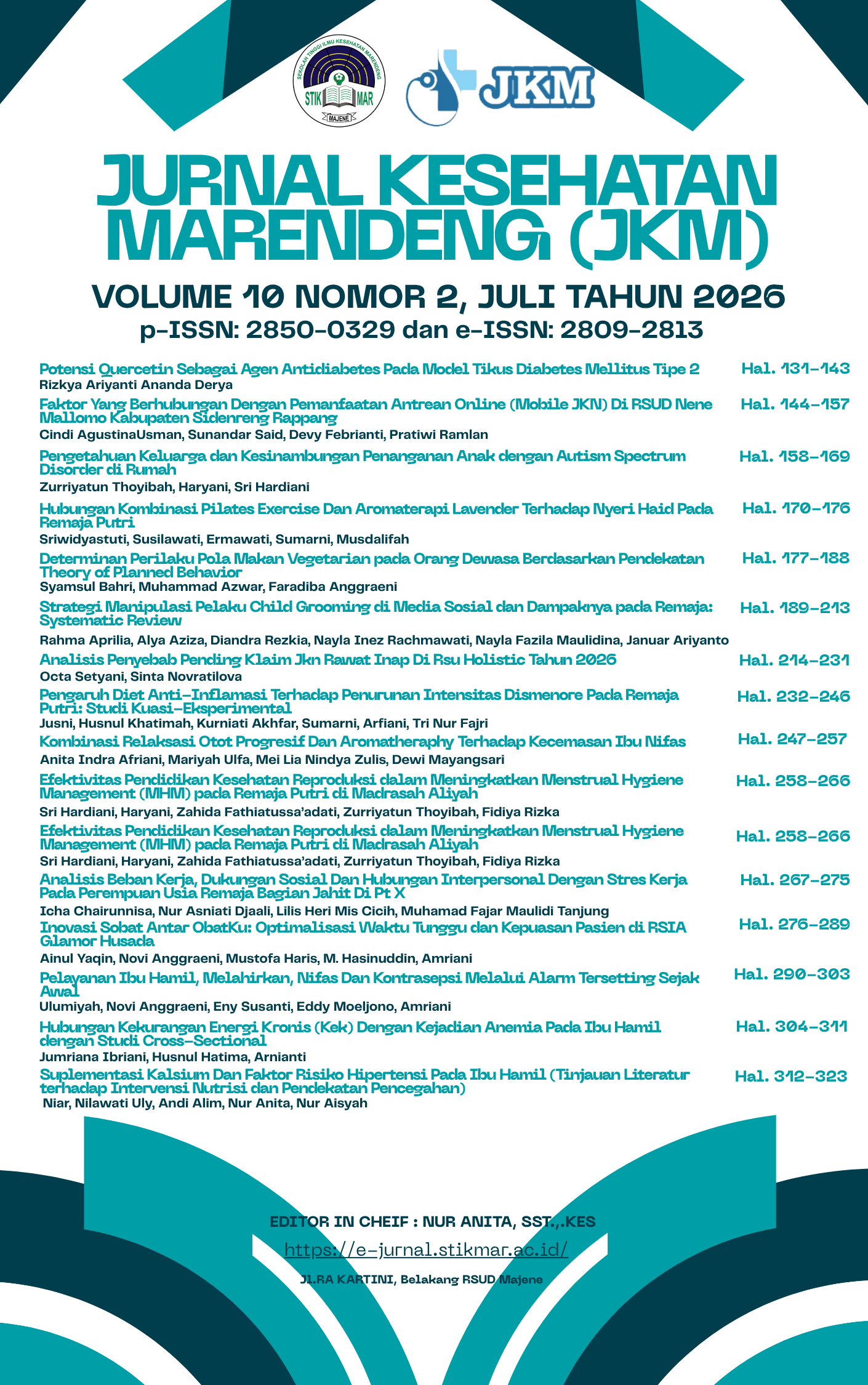
Strategi Manipulasi Pelaku Child Grooming di Media Sosial dan Dampaknya pada Remaja: Systematic Review
Article Sidebar
-
Grooming anak, Media sosial, Remaja, Strategi manipulasi, Dampak psikologis, Child grooming, Social media, Adolescents, Manipulation Strategies, Psychological impact
Abstract
The widespread use of social media among adolescents has contributed to the rise of digital-based crimes, including child grooming. This systematic review aims to examine and synthesize offenders' manipulation strategies and the psychological impacts experienced by victims. Method: Literature was searched across Google Scholar, PubMed, ScienceDirect, and GARUDA databases using the PRISMA protocol and PECO framework. Of 9,707 articles identified, 12 met the inclusion criteria and were analyzed. Result: Out of the twelve articles analyzed, ten met the MMAT quality evaluation criteria, with four of them rated as high-quality literature (five out of five). The synthesis of the findings shows that offenders implement a systematic and gradual strategy, beginning with emotional trust-building, intense attention-giving, victim isolation, and escalating to threats and coercion. Psychological impacts reported include anxiety, depression, trauma, shame, low self-esteem, social withdrawal, sleep disturbances, and relational confusion. Discussion: This review concludes that child grooming is a layered psychological manipulation process with long-term effects on victims' sense of safety and self-worth, highlighting the need for digital literacy education, improved reporting mechanisms, and comprehensive psychological intervention
References
Andaru, I. P. N. (2021). Cyber Child Grooming sebagai Bentuk Kekerasan Berbasis Gender Online di Era Pandemi. Jurnal Wanita Dan Keluarga, 2(1), 41–51. https://doi.org/10.22146/jwk.2242
Evans, C., & Lorenzo-Dus, N. (2025). A corpus-assisted discourse analysis of children’s and groomers’ talk in online grooming interactions. Applied Corpus Linguistics, 5(3), 100147. https://doi.org/10.1016/j.acorp.2025.100147
Finkelhor, D., Turner, H., & Colburn, D. (2022). Prevalence of Online Sexual Offenses Against Children in the US. JAMA Network Open, 5(10), e2234471. https://doi.org/10.1001/jamanetworkopen.2022.34471
Fortin, F., Chopin, J., & Paquette, S. (2025). Exploring behavioral patterns of child-focused online sexual solicitation: findings from a Canadian sample. Child Abuse and Neglect. https://doi.org/10.1016/j.chiabu.2025.107656
Holivia, A., & Suratman, T. (2021). Child Cyber Grooming Sebagai Bentuk Modus Baru Cyber Space Crimes. Bhirawa Law Journal, 2(1), 1–13. https://doi.org/10.26905/blj.v2i1.5847
Hong, Q. N., Gonzalez?Reyes, A., & Pluye, P. (2018). Improving the usefulness of a tool for appraising the quality of qualitative, quantitative and mixed methods studies, the
Jamaila, J. F., & Wahyuningsih, Y. Y. (2025). Juridical Analysis Of Child Grooming And Identify Forgery (Faker) In The Roleplayer Community On Social Media. Journal of Law, Politic and Humanities, 6(1), 447–456. https://doi.org/10.38035/jlph.v6i1.2510
Joleby, M., Lunde, C., Landström, S., & Jonsson, L. S. (2021). Offender strategies for engaging children in online sexual activity. Child Abuse and Neglect, 120. https://doi.org/10.1016/j.chiabu.2021.105214
Kementerian Komunikasi dan Digital Republik Indonesia. (2025). Catat 1,45 juta kasus eksploitasi seksual anak daring: Nezar Patria—literasi digital dan regulasi AI jadi kunci perlindungan. Retrieved July 12, 2026, from Kementerian Komunikasi dan Digital Republik Indonesia website: https://www.komdigi.go.id/berita/siaran-pers/detail/catat-145-juta-kasus-eksploitasi-seksual-anak-daring-nezar-patria-literasi-digital-dan-regulasi-ai-jadi-kunci-perlindungan
Kim, S., Lee, B., Maqsood, M., Moon, J., & Rho, S. (2025). Deep Learning-Based Natural Language Processing Model and Optical Character Recognition for Detection of Online Grooming on Social Networking Services. CMES - Computer Modeling in Engineering and Sciences, 143(2), 2079–2108. https://doi.org/10.32604/cmes.2025.061653
Kloess, J. A., Beech, A. R., & Harkins, L. (2014). Online Child Sexual Exploitation: Prevalence, Process, and Offender Characteristics. Trauma, Violence, & Abuse, 15(2), 126–139. https://doi.org/10.1177/1524838013511543
Komisi Perlindungan Anak Indonesia. (2026). KPAI paparkan laporan akhir tahun 2025: Potret tantangan dan penguatan perlindungan anak di Indonesia. Retrieved July 12, 2026, from Komisi Perlindungan Anak Indonesia (KPAI) website: https://www.kpai.go.id/publikasi/21608
Lausiana, D. F., & Dona, F. (2025). Cyber Grooming sebagai Ancaman Seksual di Era Digital: Perlindungan Anak Korban Cyber Grooming (Studi Kasus Yayasan Kakak Surakarta). AHKAM, 4(4), 1862–1875. https://doi.org/10.58578/ahkam.v4i4.8520
Lorenzo-Dus, N., & Evans, C. (2025). “Not right now”: Children’s resistance during online grooming interactions. Journal of Pragmatics, 249, 44–56. https://doi.org/10.1016/j.pragma.2025.08.013
Mar Negreiro. (2026). Combating child sexual abuse online.
Melo Laclote, P., Martínez-Líbano, J., Céspedes, C., Fuentealba-Urra, S., Ramírez, N. S., Lara, R. I., & Yeomans-Cabrera, M.-M. (2025). Grooming Risk Factors in Adolescents with Abuse Histories: Insights from Chilean Reparative Programs. Adolescents, 5(1), 3. https://doi.org/10.3390/adolescents5010003
Nuryah, A. S., & Warsono. (2023). Child Grooming pada Media Sosial Sebagai Modus Baru Pelecehan Seksual Anak di Desa Kedungpeluk. Jurnal Pendidikan Tambusai, 7(2), 13096–13104.
Quayle, E. (2020). Prevention, disruption and deterrence of online child sexual exploitation and abuse. ERA Forum, 21(3), 429–447. https://doi.org/10.1007/s12027-020-00625-7
Sambenaung, G. A. C., Natalia, S., & Ruata, C. (2025). Intervensi Psikoedukasi dalam Memperbaiki Konsep Diri Korban Child Grooming (Vol. 1).
Shaffril, H. A. M., Samah, A. A., & Samsuddin, S. F. (2021). Guidelines for developing a systematic literature review for studies related to climate change adaptation. 28, 22265–22277. https://doi.org/10.1007/s11356-021-13178-0
Smahel, D., Machackova, H., Mascheroni, G., Dedkova, L., Staksrud, E., Ólafsson, K., … Livingstone, S. (2020). EU Kids Online 2020: Survey results from 19 countries. https://doi.org/10.21953/lse.47fdeqj01ofo
Street, J., Ihianle, I. K., Olajide, F., & Lotfi, A. (2025). Enhanced Online Grooming detection employing Context Determination and Message-Level Analysis. Intelligent Systems with Applications, 28. https://doi.org/10.1016/j.iswa.2025.200607
Thomas, K., Hamilton-Giachritsis, C., Branigan, P., & Hanson, E. (2023). Offenders’ approaches to overcoming victim resistance in technology-assisted child sexual abuse. Child Abuse & Neglect, 141, 106143. https://doi.org/10.1016/j.chiabu.2023.106143
Thorpe, C., Jennings, F., Shams, A., Chong, L. Y., Mir, K., Barry, B., … Bowden, M. (2026). Building societal resilience against child grooming: A design thinking approach to understanding the problem and priorities. Children and Youth Services Review, 183, 108834. https://doi.org/10.1016/j.childyouth.2026.108834
Wahid, W. K., Latif, S., & Sinring, A. (2024). Analisis Kebutuhan Media BK Pada Remaja SMA dalam Mencegah Pelecehan Seksual Child Grooming. Retrieved from https://e-journal.upr.ac.id/index.php/pdhp
Wahyuningtyas, Y. W. , & Mufid, F. L. (2022). Techno Prevention sebagai Upaya Pencegahan Terhadap Pelaku Child Grooming melalui Media Sosial. JURNAL RECHTENS, 11(1), 109–122. https://doi.org/10.56013/rechtens.v11i1.1385
Authors

This work is licensed under a Creative Commons Attribution-NonCommercial-ShareAlike 4.0 International License.